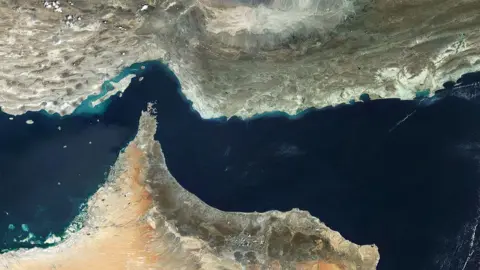
The Strait of Hormuz — a narrow, 33-kilometre-wide waterway between Iran and Oman — is the world’s single most important energy corridor. Nearly 20 million barrels of oil pass through it every day, representing about one-third of all global seaborne crude. For most countries, a disruption here means higher fuel prices. For Pakistan, it means something far more severe: an existential economic shock.
With over 80% of its crude oil imports and virtually all of its LNG supplies passing through the Strait of Hormuz, and with strategic petroleum reserves covering only 10 to 14 days of consumption, Pakistan is among the world’s most energy-vulnerable economies. As tensions in the region escalated sharply in early 2026 following the US-Israel strikes on Iran, this vulnerability moved from a theoretical risk to a lived crisis.
This blog provides a comprehensive, data-driven analysis of how the Strait of Hormuz affects Pakistan — economically, geopolitically, and strategically — and what Pakistan must do to reduce its exposure.
Table of Contents
- What Is the Strait of Hormuz?
- Pakistan’s Deep Dependence on Hormuz
- The Economic Shockwave: What Happens If It Closes?
- Scenario Analysis: Mild, Moderate & Severe Disruption
- What’s Already Happening in 2026
- Pakistan’s Path Forward: Policy Recommendations
- Conclusion
1. What Is the Strait of Hormuz?
The Strait of Hormuz is a narrow sea passage connecting the Persian Gulf to the Gulf of Oman and the Arabian Sea. It is bordered by Iran to the north and the Sultanate of Oman to the south. Despite measuring only about 33 kilometres at its narrowest navigable point, it carries an outsized share of the world’s energy trade.
According to the International Energy Agency (IEA), roughly 20 million barrels per day of crude oil and petroleum products transit the strait — approximately 31% of all global seaborne oil trade. Beyond crude oil, around 20% of the world’s liquefied natural gas (LNG) exports also move through this single chokepoint. About 90% of all Hormuz oil exports are destined for Asian markets, making it the most critical energy link between the Gulf and Asia.
Countries that depend on the strait include Saudi Arabia, the UAE, Kuwait, Iraq, Qatar, Bahrain, and Iran itself. Of these, only Saudi Arabia and the UAE have partial pipeline alternatives — and even those cannot handle full export volumes. For everyone else, there is no backup route.
A closure or major disruption of the Strait of Hormuz does not merely affect one country. It sends price shockwaves through every oil-importing economy on the planet — with South Asian nations bearing the heaviest blow.
2. Pakistan’s Deep Dependence on Hormuz
Pakistan’s structural exposure to the Strait of Hormuz is severe and operates across three interconnected dimensions: crude oil imports, LNG supply, and an almost complete absence of strategic reserves.
Crude Oil: A Near-Total Reliance
Pakistan’s domestic crude oil production is approximately 81,000 barrels per day — against a national consumption of nearly 480,000 barrels per day. The resulting deficit of roughly 400,000 barrels per day must be covered entirely through imports, of which more than 80% originate from Gulf Cooperation Council (GCC) countries — Saudi Arabia and the UAE being the primary suppliers — and transit the Strait of Hormuz.
Energy products account for over 22% of Pakistan’s total import bill, making crude oil and petroleum the single largest import category. Every $10 rise in global crude prices adds approximately $1.8 to $2.0 billion to Pakistan’s annual import expenditure.
LNG: The Qatar Problem
Pakistan’s dependence on Hormuz for LNG is even more concentrated than for crude oil. Qatar and the UAE together supply approximately 99% of Pakistan’s LNG imports. Qatar, one of the world’s largest LNG exporters, ships virtually all of its gas through the Strait of Hormuz — there is no viable alternative export route for Qatari LNG.
This creates a structural chokepoint within a chokepoint: Pakistan’s power generation, industrial sector, and domestic gas distribution are all fundamentally tethered to a maritime corridor that Islamabad has no ability to control or defend independently.
Strategic Reserves: Only Days of Buffer
Perhaps the most alarming aspect of Pakistan’s vulnerability is the near-total absence of a buffer. Pakistan’s strategic petroleum reserves cover only 10 to 14 days of consumption. By comparison, India maintains roughly 65–70 days of reserve capacity, and China holds several months’ worth of strategic stocks.
As Kpler principal analyst Go Katayama observed, Pakistan and Bangladesh have “limited storage and procurement flexibility,” meaning that a disruption would likely trigger fast power-sector demand destruction — in plain terms, blackouts and fuel shortages — almost immediately, rather than allowing time for the government to seek alternative supplies.
“A disruption in the Strait of Hormuz is not just an external event — it is a domestic macroeconomic shock in waiting for Pakistan.”
— Pakistan Institute of Development Economics (PIDE), March 2026
3. The Economic Shockwave: What Happens If Hormuz Closes?
A significant disruption to the Strait of Hormuz would not remain confined to the energy sector. It would cascade rapidly across Pakistan’s entire macroeconomic framework, affecting inflation, exchange rates, the current account, and industrial output simultaneously.
Soaring Oil Prices and Import Bills
A severe Hormuz closure could drive Brent crude prices to $150 per barrel or higher. At that level, Pakistan’s monthly petroleum import bill would surge from the current average of approximately $1.7 billion per month to between $3.5 billion and $4.5 billion per month. Annualised, the external cost of a severe disruption could exceed $4.6 billion — a catastrophic sum for an economy under IMF-supervised fiscal consolidation.
Inflation: From 7% to 17%
Pakistan’s current Consumer Price Index (CPI) inflation stands at around 7%. Research by the Pakistan Institute of Development Economics (PIDE) models the inflationary impact of a Hormuz disruption across three scenarios:
- Mild disruption: Inflation rises to approximately 9%
- Moderate disruption: Inflation rises to approximately 12%
- Severe / full closure: Inflation could reach 17%
The primary transmission mechanism is high-speed diesel (HSD), which is embedded throughout Pakistan’s supply chains — in transport and logistics, agricultural production, food distribution, and industrial manufacturing. When diesel prices spike, the cost of everything else follows. The impact on food inflation would be particularly devastating, given that millions of Pakistanis already spend a disproportionate share of their income on food.
The Rupee Under Pressure
As Pakistan’s dollar demand surges to cover higher import bills, the Pakistani rupee comes under direct downward pressure. A weaker rupee then inflates the cost of all imports further — not just fuel — creating a dangerous feedback loop: higher oil prices → more dollar demand → weaker rupee → higher import costs → more inflation → repeat. The current account, which has recently shown signs of stabilisation, could shift back into significant deficit within months of a sustained disruption.
Power Cuts and Industrial Paralysis
Pakistan’s power sector relies heavily on imported furnace oil and LNG for electricity generation. A halt in LNG shipments would rapidly translate into load-shedding beyond current levels, causing industrial productivity to fall, export competitiveness to decline, and unemployment to rise. Pakistan’s already-stressed circular debt problem would worsen dramatically.
4. Scenario Analysis: Mild, Moderate & Severe Disruption
The table below summarises the projected economic impact under the three disruption scenarios modelled by PIDE:
| Scenario | Oil Price Estimate | Monthly Import Bill | Inflation Impact | Rupee Pressure |
|---|---|---|---|---|
| Mild Disruption | $90–$100 / bbl | ~$2.1–$2.5B / month | ~9% | Moderate depreciation |
| Moderate Disruption | $100–$130 / bbl | ~$2.5–$3.5B / month | ~12% | Significant depreciation |
| Severe / Full Closure | $130–$150+ / bbl | $3.5–$4.5B / month | Up to 17% | Severe freefall risk |
Even the mildest scenario represents a meaningful deterioration in living standards. The severe scenario would be an economic emergency comparable to the 2022–2023 balance-of-payments crisis — but with an ongoing external trigger that Islamabad cannot control or negotiate away domestically.
5. What’s Already Happening in 2026
The 2026 Strait of Hormuz crisis did not emerge from nowhere. Following US-Israel coordinated airstrikes on Iran (Operation Epic Fury) on 28 February 2026, maritime traffic through the strait was severely disrupted, sending Brent crude prices up 10–13% almost immediately. War-risk insurance premiums for tankers surged, adding up to $250,000 per transit for very large crude carriers.
Pakistan’s response was rapid but necessarily improvised:
- Fuel shortages and long queues appeared at petrol stations across major cities within days of the disruption.
- On 4 March 2026, Pakistan formally requested Saudi Arabia to reroute oil supplies through the port of Yanbu on the Red Sea — an alternative route bypassing the closed strait — and Saudi Arabia arranged at least one crude shipment via this route.
- The Pakistan Navy launched Operation Muhafiz-ul-Bahr (“Protector of the Seas”) to escort tankers and protect sea lines of communication in the Gulf of Oman.
- Pakistani and Indian destroyers were deployed to escort tankers in the Gulf of Oman, though not within the strait itself.
- On 16 March 2026, a Pakistani oil tanker crossed the Strait of Hormuz with Iranian permission — a sign of the complex diplomatic balancing act Islamabad has been forced to perform.
This last point highlights a particularly acute dilemma. Pakistan’s Strategic Mutual Defence Agreement (SMDA) with Saudi Arabia — signed in September 2025 — states that an act of aggression against one party is considered an act of aggression against both. This potentially pulls Pakistan into the broader Iran-Gulf conflict, while simultaneously requiring Islamabad to maintain workable relations with Iran to keep its tankers moving.
6. Pakistan’s Path Forward: Policy Recommendations
Pakistan’s vulnerability to Hormuz disruptions is real and deep — but it is not permanent. A set of structural reforms and near-term policy actions, if implemented with urgency, can significantly reduce the country’s exposure. Analysts at PIDE and international energy bodies have outlined the following roadmap:
1. Urgently Expand Strategic Petroleum Reserves
Pakistan must increase its reserve buffer from 10–14 days to at least 30–60 days of consumption. This is the single most important near-term protective measure. It buys time for diplomatic and market responses during any future disruption and sends a signal to markets that Pakistan is not completely undefended.
2. Diversify Import Sources
Reduce over-dependence on Gulf suppliers by increasing procurement from the United States (WTI light sweet crude), West African producers, and Central Asian sources. Explore overland pipeline routes via the China-Pakistan Economic Corridor (CPEC) to reduce maritime dependency altogether.
3. Accelerate Renewable Energy Investment
Pakistan has enormous untapped solar and wind potential, particularly in Sindh and Balochistan. Accelerating renewable energy capacity directly reduces long-term exposure to oil import shocks and progressively cuts the overall energy import bill. Every megawatt of domestic renewable generation is a hedge against Hormuz.
4. Adopt Oil Price Hedging Strategies
The government should work with the State Bank of Pakistan and the Petroleum Division to implement financial hedging instruments that protect against sudden oil price spikes, similar to the hedging programmes used by airlines to manage jet fuel costs.
5. Implement a Transparent Fuel Pricing Mechanism
A rules-based, transparent fuel pricing system reduces uncertainty and prevents politically motivated price suppression that ultimately leads to circular debt and fiscal strain. Transparent pricing also enables better demand-side management during crises.
6. Strengthen Energy Efficiency
Reducing overall energy demand through efficiency improvements in industry, transport, and buildings reduces the quantum of imports needed and limits exposure to price volatility — making disruptions easier to absorb when they do occur.
7. Resolve the Iran–Pakistan Pipeline Impasse
Despite geopolitical sensitivities and the threat of US sanctions, the Iran–Pakistan (IP) gas pipeline remains a potentially transformative infrastructure project that could deliver gas without maritime dependency. Pakistan must pursue diplomatic resolution — including direct engagement with Washington — to unlock this asset.
7. Conclusion: A Wake-Up Call Pakistan Cannot Afford to Ignore
The Strait of Hormuz crisis of 2026 has exposed what energy analysts have warned about for years: Pakistan’s economy is built on a fragile foundation of imported fuel transiting a single, politically volatile chokepoint. With fewer than two weeks of petroleum reserves, a rupee prone to depreciation, an inflation rate that can double under moderate disruption, and a power sector that can be brought to its knees by a halt in LNG shipments, Pakistan has almost no buffer against an external energy shock.
A mild disruption pushes inflation to 9%. A severe one risks a full-blown balance-of-payments crisis, fuel shortages, and social unrest. The geopolitical situation in the Gulf remains deeply uncertain, and Pakistan cannot afford to wait for the next crisis before acting.
The path forward requires political will and long-term thinking: building strategic reserves, diversifying suppliers, investing in domestic renewables, hedging against price volatility, and pursuing diplomatic solutions that give Pakistan more options. The Strait of Hormuz will always matter — but it should not be existential for a country of 240 million people.
The time to act is now.
Sources & References
- Pakistan Institute of Development Economics (PIDE) — Hormuz Shock Analysis, March 2026
- International Energy Agency (IEA) — Strait of Hormuz Chokepoint Profile, 2025–2026
- Kpler Commodities Research — LNG & Crude Flow Data, March 2026
- The Express Tribune — “Instability in Hormuz and Our Economic Challenges,” March 2026
- CBS News / OilPrice.com / CNBC — Hormuz disruption coverage, February–March 2026