If you are involved in international trade — whether as an importer, exporter, freight forwarder, or logistics manager — you have almost certainly come across the acronym CIF. It appears on purchase contracts, shipping invoices, letters of credit, and customs declarations every single day.
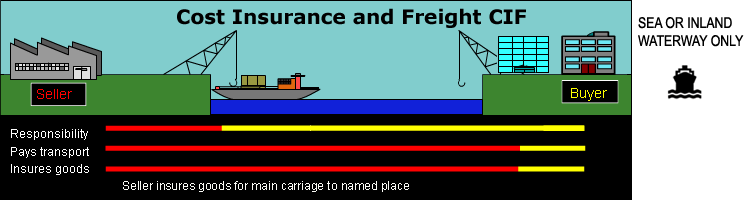
But what does CIF mean in shipping? Who pays for what? And when is CIF the right Incoterm to use — and when should you avoid it? This guide answers every question in plain, practical language.
What is CIF?
CIF stands for Cost, Insurance, and Freight. It is one of eleven internationally recognised trade terms published by the International Chamber of Commerce (ICC) under the Incoterms® 2020 ruleset.
Under a CIF agreement, the seller pays for three things: the cost of the goods, marine cargo insurance, and ocean freight to transport the shipment to a named port of destination agreed upon in the contract.
CIF is exclusively used for sea freight and inland waterway transport. It is not appropriate for containerised cargo, air freight, or road and rail shipments. For those transport modes, the correct term is CIP (Carriage and Insurance Paid To).
📌 Simple Definition: Under CIF Incoterms, the seller covers Cost + Insurance + Freight to the destination port — but risk transfers to the buyer the moment goods are loaded onto the vessel at the port of origin.
CIF Meaning — Breaking Down Each Letter
C — Cost
The seller pays the full cost of the goods, including export packaging, labelling, and all charges needed to get the goods on board the vessel at the port of shipment. This includes export customs clearance and any applicable export duties or taxes in the country of origin.
I — Insurance
The seller must arrange and pay for marine cargo insurance to protect the buyer against loss or damage during ocean transit. Under Incoterms® 2020, the minimum insurance required under CIF is Institute Cargo Clauses (C) — the most basic level of marine cover available.
⚠️ Important for buyers: ICC (C) is the minimum and excludes many common risks such as theft, contamination, and washing overboard. If you are importing high-value, fragile, or perishable goods, always negotiate ICC (A) all-risks cover in your sales contract before the shipment leaves.
F — Freight
The seller must book and pay for ocean freight from the port of shipment to the named port of destination. The seller selects the carrier and the shipping line. The freight cost is included in the CIF price quoted to the buyer — which is why CIF prices are always higher than FOB prices for the same goods.
The Critical CIF Risk Transfer Point
This is where most traders make mistakes with CIF Incoterms.
Many buyers assume that because the seller is paying freight all the way to the destination, the seller is also responsible for the goods during the entire ocean voyage. This is wrong.
Under CIF, there is a clear split between cost and risk:
- Risk transfers to the buyer at the port of origin — the moment the goods are loaded on board the vessel.
- The seller continues to pay freight and insurance all the way to the destination port — even though the risk is already the buyer’s.
This means if your goods are damaged or lost at sea, you as the buyer must file the insurance claim — even though the seller arranged the policy. This is why it is essential to always obtain a copy of the insurance certificate from your seller before the vessel departs, and to confirm that the cover level is adequate for your cargo.
Who is Responsible for What Under CIF?
| Obligation / Cost | Responsible Party |
|---|---|
| Export packaging and labelling | Seller |
| Inland transport to port of origin | Seller |
| Export customs clearance and duties | Seller |
| Loading charges at origin port | Seller |
| Ocean freight charges | Seller |
| Marine cargo insurance (min. ICC-C) | Seller |
| Risk of loss/damage during ocean transit | Buyer |
| Unloading charges at destination port | Buyer |
| Import customs clearance and duties | Buyer |
| Inland transport from destination port | Buyer |
| Delivery to buyer’s final premises | Buyer |
CIF vs FOB — What is the Difference?
CIF and FOB (Free On Board) are the two most commonly used Incoterms in international sea freight, and the choice between them matters significantly for your business.
| Feature | CIF | FOB |
|---|---|---|
| Who pays ocean freight? | Seller | Buyer |
| Who arranges insurance? | Seller | Buyer |
| Who selects the carrier? | Seller | Buyer |
| When does risk transfer? | On board at origin | On board at origin |
| Invoice price | Higher (freight included) | Lower (freight excluded) |
| Buyer control over freight | Low | High |
| Best suited for | New importers, commodities | Experienced importers |
The key practical difference: under FOB, the buyer takes control of the freight and can negotiate directly with carriers for better rates. Under CIF, the seller controls freight booking and typically builds a margin into the freight cost — meaning the buyer often pays more for shipping than they would if they arranged it themselves.
This is why most experienced importers and large trading companies prefer to buy on FOB terms and handle their own freight and insurance. CIF is more convenient for smaller or newer buyers who want a simple, all-inclusive price to their port.
When Should You Use CIF Incoterms?
✅ CIF Works Well When…
- You are a new importer who does not yet have established relationships with freight forwarders or carriers.
- You are trading bulk commodities — grain, coal, crude oil, metals, and agricultural products — where CIF has been the accepted market convention for over a century.
- Your shipment is financed through a letter of credit (L/C). Banks require a clean bill of lading, insurance certificate, and commercial invoice — all documents the seller provides under CIF, making it ideal for documentary credit transactions.
- You are importing from a market where arranging your own freight is impractical or expensive due to local regulations or limited carrier access.
- You are shipping break-bulk or non-containerised cargo on ocean vessels.
🚫 Avoid CIF When…
- You are shipping containerised cargo (FCL or LCL). Under containerised shipping, the goods are handed to the carrier at an inland container terminal — not at the ship’s side. Using CIF means the risk transfers before the container even reaches the port, leaving you in a gap period with no clear coverage. Use CIP instead.
- You want full transparency and control over freight costs. With CIF, the freight margin is hidden inside the seller’s price. Use FOB and book your own freight.
- Your cargo requires comprehensive insurance (ICC-A). The seller’s minimum CIF insurance may not cover your actual risk exposure.
- You are shipping by air, road, rail, or multimodal transport. CIF does not apply — use CIP, CPT, or another appropriate Incoterm.
CIF Under Incoterms® 2020 — Key Updates
The International Chamber of Commerce released Incoterms® 2020 as the current governing edition. Here is what changed for CIF specifically:
Insurance minimum confirmed. The 2020 rules explicitly state that the seller must provide a minimum of Institute Cargo Clauses (C) cover. If a buyer needs ICC (A) or ICC (B), this must be agreed in writing in the contract.
Own transport now permitted. The 2020 edition recognises that a seller or buyer may use their own transport rather than a third-party carrier — a practical update for larger companies with in-house logistics.
Security requirements strengthened. Both parties now have clearer obligations to cooperate on security-related information for customs and border authorities.
Explicit warning on containerised cargo. The 2020 edition includes stronger guidance notes telling traders that CIF is not appropriate for containerised shipments — a long-standing source of costly errors in international trade.
A Real-World CIF Shipping Example
A fabric exporter in Lahore, Pakistan sells a shipment of cotton textile to a clothing brand in Hamburg, Germany, on CIF Hamburg terms. Here is what happens step by step:
- The Pakistani seller completes export packing and customs clearance in Lahore.
- The seller arranges inland transport to Karachi Port and pays all loading charges.
- The seller books a vessel and pays ocean freight from Karachi to Hamburg.
- The seller purchases marine cargo insurance (ICC-C minimum) for the shipment value plus 10%.
- Risk transfers to the German buyer the moment the fabric is loaded on board the vessel in Karachi.
- The seller sends the buyer the bill of lading, commercial invoice, packing list, and insurance certificate.
- The vessel arrives in Hamburg. The buyer pays import customs duty, VAT, and port handling charges.
- The buyer arranges inland delivery from Hamburg Port to their warehouse.
If the fabric is damaged during the ocean voyage, the buyer must file a claim directly with the insurance company — using the certificate the seller provided. The seller’s financial obligation ended when the goods were loaded in Karachi.
Frequently Asked Questions About CIF
What does CIF stand for in shipping?
CIF stands for Cost, Insurance, and Freight. It is an international trade term (Incoterm) under which the seller pays the cost of goods, marine insurance, and ocean freight to the named destination port.
What is a CIF price?
A CIF price is an all-inclusive price that covers the cost of goods + marine insurance + ocean freight to the destination port. It does not include import duties, taxes, unloading charges, or inland delivery at the destination — those are paid by the buyer.
Who pays import duty under CIF?
The buyer pays all import duties, taxes, and customs clearance charges at the port of destination. The seller’s obligations end when the goods are on board the vessel at the origin port.
Is CIF better for the buyer or the seller?
CIF tends to favour the seller, who controls freight booking and can embed a profit margin in the shipping cost. However, it is more convenient for new or smaller buyers who prefer a simple, all-inclusive delivered price without managing freight themselves.
Can CIF be used for air freight?
No. CIF is restricted to sea freight and inland waterway transport only. For air freight or multimodal containerised shipments, use CIP (Carriage and Insurance Paid To) instead.
What is the difference between CIF and CIP?
CIF is for sea/waterway transport only and requires minimum ICC (C) insurance. CIP applies to all transport modes — including containerised and air shipments — and requires the higher ICC (A) all-risks insurance as a minimum under Incoterms 2020. For most modern containerised trade, CIP is the more appropriate choice.
When does risk transfer under CIF?
Risk transfers from seller to buyer when the goods are loaded on board the vessel at the port of shipment — regardless of the fact that the seller continues to pay freight and insurance all the way to the destination port.
Key Takeaways
CIF (Cost, Insurance, and Freight) is one of the most widely used Incoterms in global sea trade, particularly for bulk commodities and letter-of-credit transactions. The seller pays freight and insurance to the destination port, but risk passes to the buyer at the port of origin. For containerised cargo, CIP is the better choice. For maximum buyer control over costs, negotiate FOB instead.
Understanding CIF Incoterms correctly can save your business from costly disputes, insurance gaps, and unexpected freight charges. If you are unsure which Incoterm is right for your next shipment, consult a licensed freight forwarder or trade professional.