Everything Businesses Need to Know About Moving Cargo Worldwide
Freight Shipping: The Backbone of Global Trade
Every product on a store shelf, every online order delivered to a customer’s doorstep, and every shipment arriving at a manufacturing facility has one thing in common: freight shipping.
Whether it’s electronics traveling from Asia, textiles exported from Pakistan, or inventory being sent to Amazon warehouses in the United States, freight shipping keeps global commerce moving.
Yet many business owners and importers still struggle to understand the differences between shipping methods, freight costs, customs procedures, and transportation options.
This guide explains freight shipping in practical terms, helping businesses make smarter logistics decisions while reducing costs and avoiding delays.
Key Takeaways
- Freight shipping is the transportation of commercial goods by air, sea, road, or rail.
- Sea freight is generally the most cost-effective option for large international shipments.
- Air freight provides the fastest transit times for urgent cargo.
- Freight rates are influenced by weight, dimensions, distance, fuel costs, and shipping mode.
- Consolidated shipping helps businesses reduce transportation expenses.
- International shipping requires proper documentation and customs clearance.
- Understanding shipping terms can prevent costly mistakes during import and export operations.
What Is Freight Shipping?
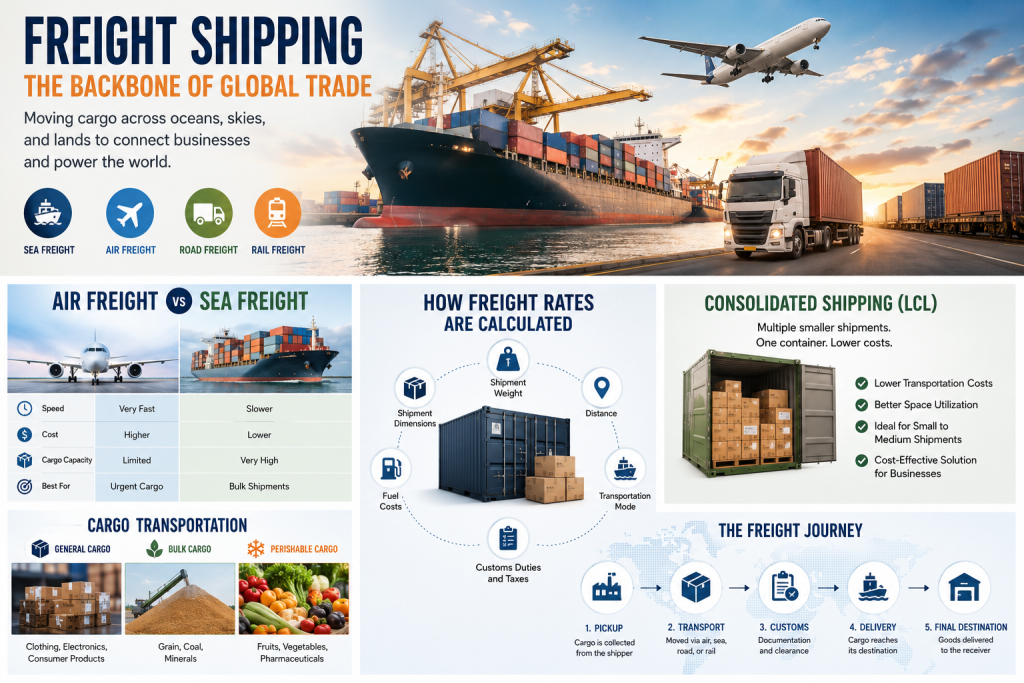
Freight shipping is the movement of commercial goods from one location to another using transportation networks such as ships, aircraft, trucks, and trains.
Unlike parcel delivery, freight shipping typically involves larger shipments intended for businesses, manufacturers, wholesalers, retailers, and importers.
Freight can range from a few pallets of products to entire shipping containers filled with cargo.
In today’s interconnected economy, freight shipping plays a critical role in maintaining supply chains and supporting international trade.
Why Freight Shipping Matters
Freight shipping matters because it connects manufacturers, suppliers, retailers, and consumers across the world.
Without reliable freight transportation, businesses would face inventory shortages, delayed production schedules, and increased operating costs.
Modern logistics allows companies to source materials globally while serving customers in multiple countries.
For growing businesses, choosing the right freight solution can directly impact profitability and customer satisfaction.
Types of Freight Transportation
Different transportation methods serve different business needs.
Air Freight
Air freight is the fastest method of cargo transportation.
Best For:
- Urgent shipments
- High-value products
- Electronics
- Medical supplies
- Time-sensitive inventory
Advantages:
- Fast transit times
- High security
- Reliable scheduling
Limitations:
- Higher transportation costs
- Weight and size restrictions
Sea Freight
Sea freight moves cargo through container vessels and cargo ships.
Best For:
- Large-volume shipments
- International trade
- Industrial equipment
- Consumer products
Advantages:
- Lowest cost per unit
- Suitable for bulk cargo
- Global reach
Limitations:
- Longer transit times
- Port congestion risks
Road Freight
Road freight uses trucks and trailers to move cargo domestically and regionally.
Advantages:
- Door-to-door service
- Flexible delivery routes
- Faster regional transportation
Common Uses:
- Retail distribution
- Manufacturing supply chains
- Last-mile delivery
Rail Freight
Rail freight provides an efficient solution for transporting large quantities of cargo across long distances.
Advantages:
- Lower environmental impact
- High cargo capacity
- Competitive pricing
Air Freight vs Sea Freight
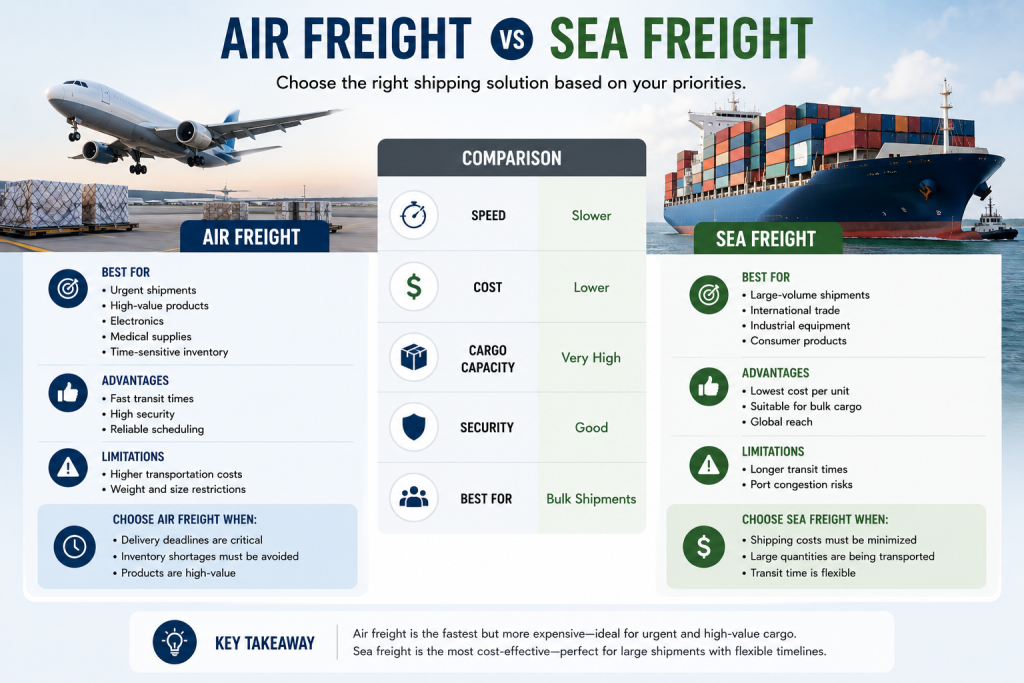
Choosing between air freight and sea freight depends on your priorities.
| Factor | Air Freight | Sea Freight |
|---|---|---|
| Speed | Very Fast | Slower |
| Cost | Higher | Lower |
| Cargo Capacity | Limited | Very High |
| Security | Excellent | Good |
| Best For | Urgent Cargo | Bulk Shipments |
Choose Air Freight When:
- Delivery deadlines are critical
- Inventory shortages must be avoided
- Products are high-value
Choose Sea Freight When:
- Shipping costs must be minimized
- Large quantities are being transported
- Transit time is flexible
Sea Freight vs Road Freight
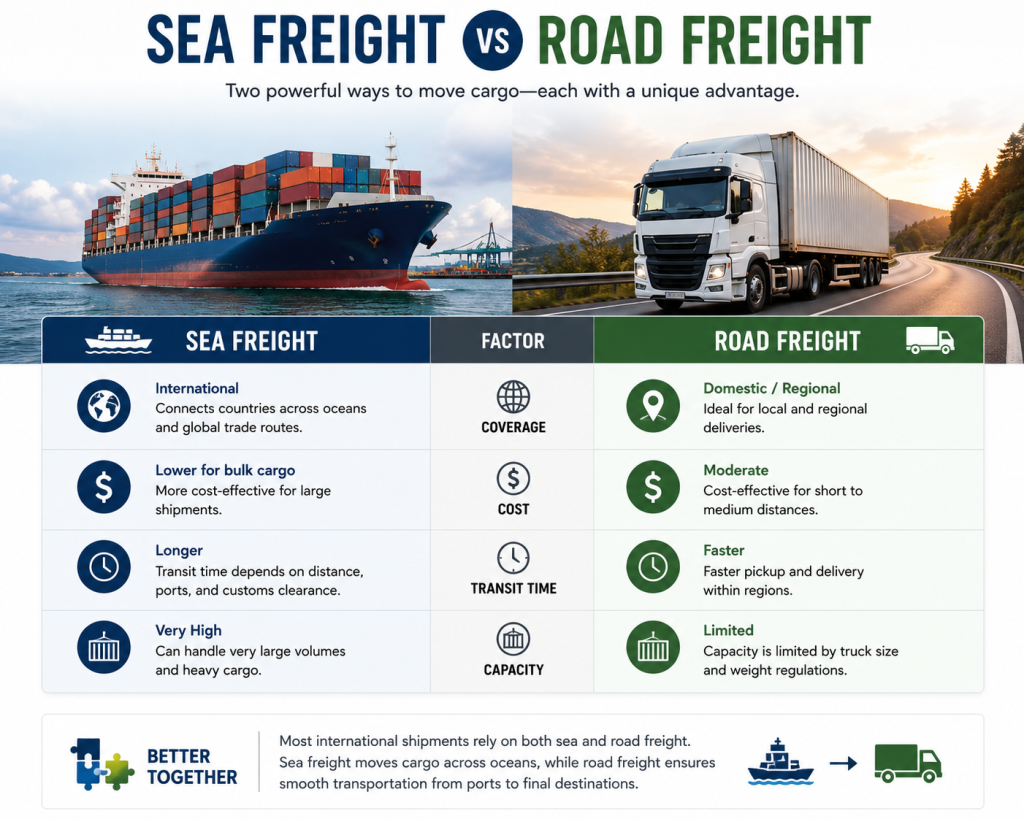
Sea freight and road freight serve different logistics purposes.
| Factor | Sea Freight | Road Freight |
| Coverage | International | Domestic/Regional |
| Cost | Lower for bulk cargo | Moderate |
| Transit Time | Longer | Faster |
| Capacity | Very High | Limited |
Most international shipments rely on both methods as part of a multimodal logistics strategy.
How Freight Rates Are Calculated
Freight pricing is based on several important factors.
Shipment Weight
Heavier cargo generally costs more to transport.
Shipment Dimensions
Carriers often calculate pricing using dimensional weight.
Distance
Longer shipping routes increase transportation costs.
Transportation Mode
Air freight costs significantly more than sea freight.
Fuel Costs
Fuel surcharges can impact freight rates considerably.
Customs Duties and Taxes
International shipments may include additional government charges.
Understanding these variables helps businesses estimate logistics budgets more accurately.
What Is Consolidated Shipping?
Consolidated shipping combines multiple smaller shipments into a single transportation unit.
This allows businesses to share transportation costs while maximizing cargo space utilization.
Common Types
LCL (Less Than Container Load)
Multiple importers share one shipping container.
- Benefits
- Lower transportation costs
- Better container utilization
- Reduced environmental impact
What Is Cargo Transportation?
Cargo transportation refers to the movement of goods through logistics networks using various transportation modes.
General Cargo
- Clothing
- Electronics
- Consumer products
Bulk Cargo
- Grain
- Coal
- Minerals
Perishable Cargo
- Fruits
- Vegetables
- Pharmaceuticals
Dangerous Goods
- Chemicals
- Batteries
- Flammable products
Each category requires specialized handling and compliance procedures.
How International Shipping Works
International shipping involves multiple stages that must be coordinated carefully.
Step 1: Shipment Booking
A freight forwarder arranges transportation.
Step 2: Cargo Collection
Goods are picked up from the supplier.
Step 3: Documentation
Required documents typically include:
- Commercial Invoice
- Packing List
- Bill of Lading
- Certificate of Origin
- Air Waybill
Step 4: Customs Clearance
Authorities verify compliance with import and export regulations.
Step 5: International Transportation
Cargo travels by air, sea, rail, or road.
Step 6: Destination Customs Clearance
Import procedures are completed.
Step 7: Final Delivery
Goods are delivered to the consignee.
Understanding Freight Classifications
Freight classifications help carriers determine pricing and handling requirements.
Factors include:
- Weight
- Density
- Value
- Handling difficulty
- Liability risk
Proper classification prevents unexpected charges and shipment delays.
Common Shipping Terms Explained
FOB (Free on Board)
The seller’s responsibility ends once goods are loaded onto the vessel.
CIF (Cost, Insurance, and Freight)
The seller covers transportation and insurance to the destination port.
DDP (Delivered Duty Paid)
The seller pays duties, taxes, and delivery costs.
DAP (Delivered at Place)
The buyer pays import duties and taxes.
FCL (Full Container Load)
One customer uses the entire container.
LCL (Less Than Container Load)
Multiple customers share container space.
Bill of Lading
A legal shipping document issued by the carrier.
Air Waybill
The primary transportation document used in air freight.
Practical Applications for Businesses
Businesses can optimize supply chains by selecting freight solutions that match their goals.
Importers and Exporters
Use sea freight for cost efficiency and air freight for urgent shipments.
Amazon FBA Sellers
Leverage DDP shipping to simplify imports into fulfillment centers.
E-Commerce Companies
Use consolidated shipping to reduce transportation expenses.
Conclusion
Freight shipping remains the foundation of international trade and modern supply chains. Understanding transportation methods, freight costs, customs procedures, cargo classifications, and shipping terminology enables businesses to make informed logistics decisions.
Whether you are importing products, exporting goods, managing Amazon FBA inventory, or expanding into international markets, choosing the right logistics partner is essential.
Qaas Freight System provides reliable air freight, sea freight, customs clearance, courier services, and global logistics solutions designed to help businesses move cargo efficiently and cost-effectively.
Contact Qaas Freight System
For professional freight forwarding and logistics support, contact Qaas Freight System today and discover how efficient shipping can help your business grow.Freight Shipping: The Backbone of Global Trade